Los Angeles lives outdoors. Mornings start on the patio with coffee. Evenings gather around firelight. Weekends revolve around kids in the pool, a game on the patio TV, food coming off the grill, and friends who never seem to leave. When people ask Ridgeline to design a resort-style backyard, they are not asking for something grand for the sake of it. They want their home to work like a boutique hotel that just happens to be theirs - beautiful, intuitive, comfortable, and easy to maintain.
The challenge is turning aspiration into something that works on a Wednesday at 6 p.m. After a long day on the 405. That takes more than a Pinterest board. It takes layout, grading, drainage, plant selection, code compliance, acoustics, lighting levels, and finishes that keep looking good after a few summers of sun. It also takes a builder who understands Los Angeles soils and microclimates, from breezy Westchester to baking Woodland Hills to the tight setbacks of Silver Lake hillsides.
What follows is how our team thinks, draws, and builds to make everyday resort living feel effortless, while solving the very unglamorous issues that derail a lot of backyard projects.
Start with how you live, not what you saw at a hotel
We always begin with a site walk and real questions. How many people do you host when you actually throw a party, not the fantasy number. Who cooks, and what do they cook. Where does the wind come from at sunset. Which neighbor is the noise-sensitive one. Do you have dogs that run the fence line. Are there kids under eight who need sightlines to the pool.
One Hancock Park couple wanted a 12-foot outdoor bar because they loved resorts in Cabo. On site we learned their gatherings were six to eight people, and they both cooked multi-course meals. Their “bar” became a U-shaped outdoor kitchen with a 36-inch grill, 24-inch flat top, undercounter fridge, a prep sink, and a 9-foot dining banquette shaded by a pergola. It matched their reality, not a marketing photo.
Resort style, properly understood, means frictionless. You should not walk 80 feet with a platter or turn your back on guests to cook. The good seats need shade midafternoon. The spa should be two steps, not a cold march, from the house on a winter night. Every decision gets measured against use, sun, wind, and maintenance.
Zoning the backyard like a small campus
Most Los Angeles lots need zones that connect fluidly. We think of four anchors.
The social hearth anchors are fire features, dining, and the kitchen. These belong closest to the house because they get used most nights and plug neatly into utilities. If the kitchen is across the lawn, it will not get used. We aim for 12 to 18 feet from the indoor kitchen to the outdoor cooking zone, with a path wide enough for two people to pass.
The quiet zones are tucked a bit further out. A chaise lounge terrace behind plantings, a reading bench set into a shade garden, or a small deck that captures breezes. When clients ask for “10 Outdoor Living Ideas Transforming Los Angeles Backyards,” these quiet subspaces make the list because they extend the day without feeling like an event.
Play and activity zones flex by family. A synthetic turf panel for soccer passes, a basketball key off the driveway, a plunge pool with a Baja shelf, or a compact spa where space is tight. Where a pool is present, we approach it the way we would for “Pool Landscaping Ideas for Los Angeles Homes,” making sure pool equipment sits on a sound pad away from windows, shielded with sound-absorbing fencing and plantings. Safety barriers should meet code without looking like a cage.
Service and storage zones earn little love in mood boards, but they keep things pretty. A trash and bin corral, discreet pool equipment enclosure, hose bibs and quick connects, and a small utility closet for cushions and tools mean the patio does not become an obstacle course.
Surfaces that wear well and feel right underfoot
Hardscape choice is where budgets can swing and aesthetics snap into place. “Paver Patios vs Stamped Concrete: Pros and Cons” comes up weekly. Pavers suit many Los Angeles homes because they move with soils, can be repaired one module at a time, and come in styles from European cobble to clean modern plank. They pair well with porcelain or natural stone accents and do not crack as monolithically as concrete. Stamped concrete can be less expensive per square foot in simple patterns, but patching is never invisible, and heat reflectivity and slipperiness vary by finish. For steep drives, broomed concrete or textured pavers beat smooth surfaces on traction.
We like to tune material temperature and texture to microclimate. On hot Valley lots we avoid dark limestone or black porcelain around pools because surface temperatures spike. In cool coastal air, a denser porcelain paver or a light granitic concrete finish keeps mildew at bay and stays easy to clean. For families wanting “15 Paver Patio Designs Los Angeles Homeowners Love,” we often mix formats - a large 24 by 36 porcelain dining terrace stepping to a smaller-format permeable paver lounge framed by planting. Variation adds interest, and permeable zones reduce runoff.
Curbs, steps, and edge treatments matter more than people expect. A 2-inch eased stone coping at the pool feels good to sit on, while a 4-inch square-edge precast reads more architectural. Stair risers at 6.5 to 7 inches, not the standard exterior 7.5, make lazy barefoot climbs feel luxurious. These little ergonomic choices say resort without a sign.
Shade that makes a patio work all day
Midafternoon LA sun ruins many lovely patios. We test shade angles on site, not just in software, and position structure to catch west light. Clients often ask, “Pergolas vs Covered Patios: Which Is Right for Your Home?” The answer depends on sun, rain expectations, and budget. Use the following decision points to steer the choice.
- Desired weather protection: a solid roof blocks both sun and occasional rain; a pergola or louvered system filters sun but sheds limited water. Heat management: solid roofs pair well with ceiling fans and recessed heaters; pergolas rely on airflow and can take strip heaters if the structure allows. Setback and height constraints: attached covers often trigger more permitting scrutiny; standalone pergolas can navigate tight setbacks with less structural load. Aesthetic goals: pergolas cast changing shadows and read lighter; solid covers integrate lighting cleanly and can hide wiring and speakers. Cost range: quality alumawood or steel pergolas can start in the low five figures; engineered, finished-roof patio covers run higher due to framing, roofing, and electrical scope.
We also exploit plant-based shade. A fastigiate olive row can cool a west property line without stealing much width. On a tight Silver Lake slope, we once stretched stainless cabling between steel posts and trained star jasmine overhead, creating a scented green canopy for one third the cost of a roofed cover.
Planting for a beautiful, water-wise four-season garden
A resort yard in Southern California should smell good, move in the wind, and sip water. “Why Drought-Tolerant Landscaping Is a Smart Investment” is not just about savings. Plants adapted to our climate live longer and look better with less coddling. We group by water need, place highest demand plants nearest the hose, and set everything on smart irrigation with matched-precipitation heads or inline drip.
Clients often weigh “Artificial Turf vs Sod: What’s Best for Los Angeles Homes?” For families who want a green panel to play on and do not like maintenance, modern synthetic turf is pragmatic. It needs proper base prep, a compacted and graded aggregate, and a gapped perimeter to drain. It also benefits from infill choices that stay cooler, like coated sands rather than black crumb rubber. Real sod still wins for natural cooling, biodiversity, and a softer foot feel, but it asks for more water and diligent care. Where dogs are present, a small disinfectable turf run adjacent to a real-plant garden can be the sweet spot.
For planting palettes, we rely on evergreen structure - olives, arbutus, dwarf citrus, and sculptural agaves - with perennials like salvia, lavender, and yarrow for movement and seasonal color. In shady pockets, lomandra, dianella, and fortnight lily stand up to pool splash. “The Best Drought-Tolerant Plants for Los Angeles Yards” are not necessarily dull. Kangaroo paw varieties deliver saturated color against modern pavers, and manzanita cultivars give you sculptural trunks that only grow more interesting.
Mulch and soil prep close the loop. We amend heavy clay with compost and gypsum where appropriate, but we do not overwork slopes because that destabilizes them. A 2 to 3 inch mulch blanket saves water and protects soil life. Planting twice a year - a spring refresh and a late fall tune - keeps a resort yard looking camera-ready without constant replanting.
Business Name: Ridgeline Outdoor Living
Address: 845 E Walnut St, Pasadena, CA 91101, United States
Phone: (626) 469-5822
Ridgeline Outdoor Living
Ridgeline Outdoor Living is a Pasadena-based landscape design-build company serving Greater Los Angeles with custom outdoor living, hardscape, and drought-tolerant landscape solutions. The company specializes in patios, retaining walls, outdoor kitchens, drainage, hillside projects, and turnkey landscape construction, handling projects from design and permitting through final build and warranty.
845 E Walnut St, Pasadena, CA 91101, USA
Business Hours:
- Monday – Saturday: 8:00 AM – 6:00 PM
- Sunday: Closed
Follow Us:
The quiet, critical layer: grading and drainage
Nothing ruins an outdoor living space faster than standing water or settlement. We design grading before aesthetics. On flat yards, gentle 1 to 2 percent slopes move water to drains. On hillsides, we break hardscapes into terraces to shorten water runs and relieve pressure. “French Drains Explained: Protecting Your Property From Water Damage” becomes more than a blog title when your neighbor’s lot sits higher than yours. In that case, an interceptor drain at the toe of the slope, wrapped in filter fabric with clean gravel and a perforated pipe, catches and routes water before it reaches hardscape.
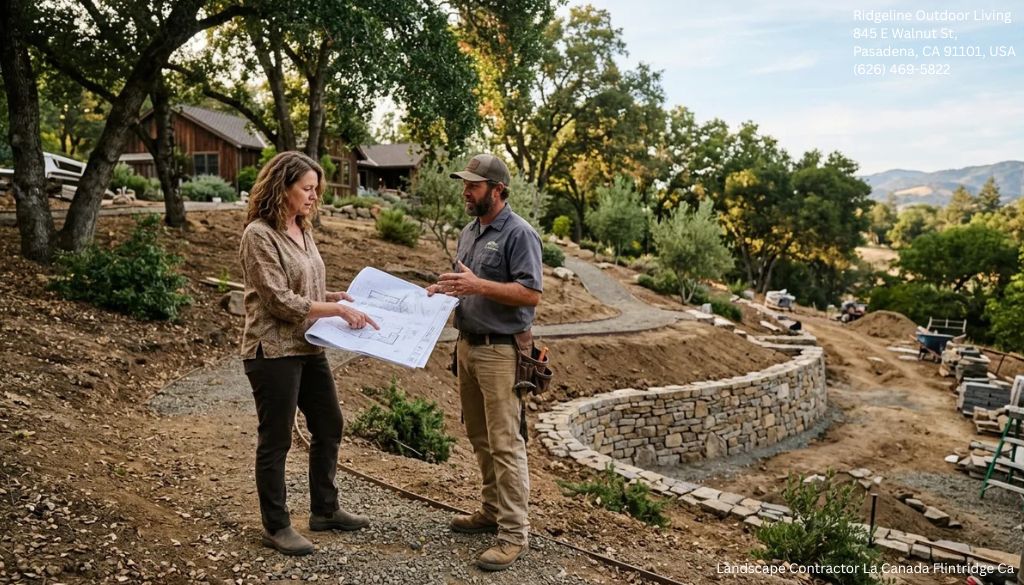
“Retaining Walls for Hillside Properties: What Homeowners Need to Know” is its own course. In Los Angeles, any wall over certain heights needs engineering and often a permit. We use geogrid soil reinforcement where backfill allows, and we specify proper drainage behind walls - a perforated pipe at footing level, a gravel backfill zone, and weep outlets that do not stain the face. Veneer choices range from split-face block to panelized stone to smooth plaster, but the strength sits in tied-back engineering you never see.
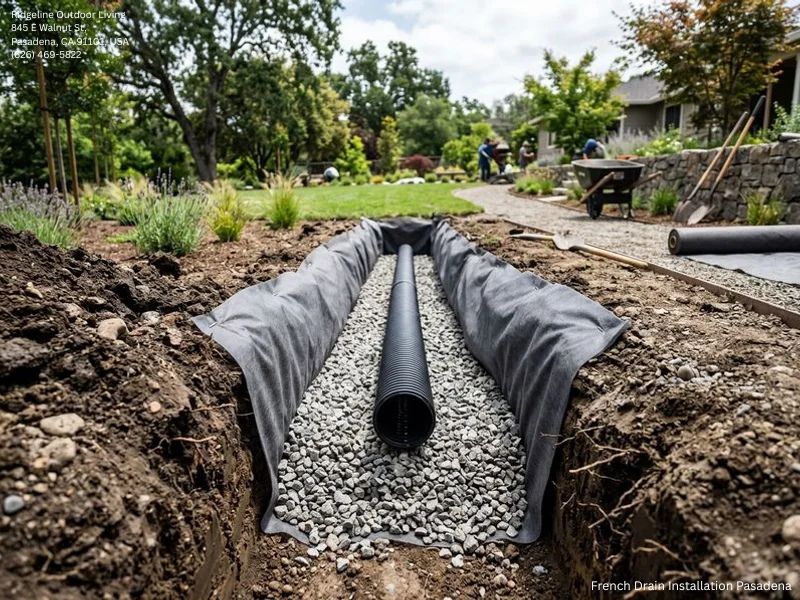
Walk any Ridgeline job mid-construction and you will see drains every 200 to 400 square feet, each with a maintenance plan. Catch basins must be accessible for cleanout. Downspouts get tied into the system rather than dumping on patios. We design for the rare but real LA storm, not last year’s forecast. “How to Prevent Yard Flooding With Proper Drainage Solutions” matters because it protects finish surfaces and keeps entertainment spaces usable year-round.
Fire, water, and the art of centering a gathering
The quickest way to create a resort feeling is to give people a reason to sit and stay. “12 Backyard Fire Pit Ideas for Entertaining Year-Round” could fill an afternoon, but the crucial calls are fuel, scale, and wind. Natural gas is clean and controllable; propane is flexible where gas is unavailable. Wood remains romance, but smoke and air quality rules restrict use in many neighborhoods. We size fire features to people - a 42 to 48 inch round pit seats six comfortably; a 72 inch linear pairs well with a long sofa. Wind breaks can be a low glass shield, a hedge, or simply a repositioned pit out of the prevailing breeze.
Water features calm a yard and tune its acoustics, masking street noise. For “12 Water Feature Ideas for Luxury Los Angeles Backyards,” we often pull from three: a blade weir into a pool that glows at night, a simple basalt column trio near an entry walk, or a reflective trough along a dining wall. We avoid overly complex fountains that become calcium-streaked maintenance projects. A small inline filter, a fill valve tied to irrigation, and a discreet overflow spare a lot of headaches.
The outdoor kitchen, tuned to how you cook
People love to ask, “How Much Does an Outdoor Kitchen Cost in Los Angeles?” A reasonable range for a well-built, plumbed, and wired kitchen with quality appliances typically starts around the mid-teens and runs into the $40k to $80k bracket, depending on length, appliances, finishes, and site complexity. Gas trenching, panel best landscaping companies in Pasadena upgrades, or hillside footings push costs upward. A compact 8 to 10 foot run with a 32 to 36 inch grill, undercounter fridge, trash, and storage in stucco or porcelain with quartzite counters often lands in the $18k to $35k zone. Add a pizza oven, sink, icemaker, and a 12 to 16 foot layout with steel or masonry framing, and you can double that number quickly.
We also discuss “Outdoor Kitchen Trends Los Angeles Homeowners Are Choosing,” which now lean toward versatile cooking: a primary gas grill paired with a flat top for vegetables and smashburgers, or a ceramic cooker for slow weekends. Counter height matters, especially for primary cooks under 5'6" or over 6'2". We like 36-inch counters for grilling, 38 inches for bar seating, and at least 24 inches of landing space on either side of a grill. Shade over the cook is non-negotiable in the Valley.
If budget requires prioritizing, these upgrades return value in daily use.
- A side burner or flat top for sauces and vegetables, so the indoor stove stays clean. A covered GFCI outlet rail for blenders and small appliances. Pullout trash and recycling to keep pests down. Drawer storage for tools, mitts, and grill brushes to avoid the garage shuffle. Task and toe-kick lighting so cooking after dark feels effortless.
We avoid porous or delicate counters outdoors. Dense porcelain slabs or honed quartzites wear best. We also specify venting and fire clearances precisely, especially at stucco or siding walls. Poorly vented kitchens age badly and risk safety.
Lighting that edits the night
Great resort yards feel cinematic after dark because lighting pulls your eye where it matters and leaves the rest in silhouette. We run layered circuits: warm 2700K path and step lights, narrow-beam accent lights into canopies or walls, low-wattage wash lights under seating, and dimmable downlights under roofed structures. “10 Outdoor Lighting Ideas for Los Angeles Landscapes” often starts with the simplest fix - dimmers and zones. A single on-off circuit rarely flatters a space.
We design to avoid “10 Outdoor Lighting Mistakes That Reduce Curb Appeal,” like glare bombs at eye level, overlit facades that blow out texture, and blue-white lamps that feel commercial. Light the verticals - tree canopies, stone walls, water - and you will need less light on the flat. Respect neighbors. Shielded fixtures and thoughtful aiming keep the sky dark and friendships intact.
Driveways and entries that boost daily pride
Curb appeal is not vanity; it sets your mood every time you arrive. “15 Driveway Paving Ideas to Improve Curb Appeal” ranges from grid-set concrete panels with dymondia joints in Santa Monica to crisp charcoal pavers with a granite band in Pasadena. “The Most Popular Driveway Materials in Los Angeles” still include concrete for cost and simplicity, but permeable pavers have risen because they reduce runoff fees in some jurisdictions and keep surfaces tidy in storms. Where budget allows, we shape a motor court with a simple water rill or specimen olive to signal arrival without fuss.
Hillsides require respect and the right team
“The Complete Guide to Hillside Landscaping in Los Angeles” could overwhelm quickly. The short version: we test soils where needed, we work with structural engineers early, and we stage construction to protect slopes. “How Retaining Walls Prevent Erosion on Hillside Properties” is not theoretical when you watch winter storms. We design slow water, not fast water, with check steps, planting bands, and multiple discharge points. On view lots, we keep walls low and layered, then borrow scenery with simple plant palettes so the view remains the star.
Sequencing a clean build
Even the best design falls apart if the build is chaotic. Our sequence favors dry utilities early - main trenching for gas, power, and sleeves - before finishes go in. Drainage and subgrades come next, then walls and structures, then flatwork, and only then planting, irrigation, and lighting. We keep saw cuts away from finished stone. We protect new concrete from early furniture feet. We test irrigation and lighting before backfilling trenches. And we leave a maintenance guide that explains filter cleanings, sealer schedules, and seasonal irrigation adjustments. “Why Professional Landscape Design Saves Time and Money” often shows up here - clean sequencing avoids rework that burns budget.
Two real backyards, two different resorts
In Sherman Oaks, a family with two small kids wanted a compact resort that did not swallow their whole yard. We created a 12 by 18 porcelain paver terrace with a 10-foot steel pergola, a 9 by 16 plunge pool with a 6-foot Baja shelf, and a 14-foot kitchen run with a grill and flat top. A hedged ficus microcarpa ‘Nitida’ screen, broken with olives and feathery muhly grass, softened property lines. Artificial turf defined a 12 by 20 play panel. We tucked a tankless heater and equipment behind a batten fence. Gas and power ran the short route under a new path, saving $6k in trenching. The result felt like a boutique hotel courtyard, yet the kids could be seen from the kitchen.
In Mount Washington, the brief read impossibly: create entertaining zones on a steep, irregular lot. We stepped the yard into three terraces: an upper dining deck level with the back door, a middle lounge centered on a linear gas fire feature with a canyon view, and a lower garden with native grasses and a small water bowl. Retaining was handled with a geogrid-backed block wall faced in plaster, softened by manzanita and coast rosemary. Interceptor drains captured uphill water, routed into a daylighted swale at the street. Lighting relied on soft uplights into toyon and oak canopies with no glare to neighbors. The yard now hosts 20 comfortably, yet it reads quiet and native, not overbuilt.
What adds value and what to skip
“10 Hardscaping Features That Increase Property Value” align closely with daily usability: a well-lit patio, a functional outdoor kitchen, a fire feature, thoughtful shade, and clean drainage. “12 Outdoor Living Features That Add the Most Value” also include low-maintenance planting and modern irrigation. Items that rarely pay off: oversized water features that guzzle energy, fireplaces placed far from seating, and specialty kitchens that require a chef to operate. When asked for “10 Backyard Upgrades Worth the Investment,” we steer clients to foundational moves - grading, drainage, quality surfacing, shade, and lighting - before statement pieces.
Costs and tradeoffs, plainly explained
People appreciate directness on budgets. “What Does Hardscape Construction Cost in Los Angeles?” varies widely, but quality patios with utilities, lighting, and planting typically start in the low six figures on full-yard renovations. Material choices, site access, engineering, and utilities drive variance. “Paver Patios vs Stamped Concrete” might swing a patio’s material line item by 15 to 35 percent. A fully realized backyard with pool, structures, kitchen, and terracing on a hillside will land much higher due to engineering and staging.
That said, we often phase projects. Get grading, drainage, and primary patios right; rough-in utilities for future features; then layer in kitchens or pergolas the following season. Phasing preserves design integrity without financial strain.
Common pitfalls we avoid for clients
A few lessons repeat. “10 Hillside Landscaping Ideas for Challenging Properties” fail when irrigation leaks go undetected. We specify pressure-regulating valves and sensors that shut off when leaks occur. “Common Landscape Drainage Problems and Their Solutions” include downspouts dumping onto patios and undersized outlet lines. We fix both at design time. landscaping guides “10 Backyard Renovation Mistakes to Avoid” include overfilling planters with shallow soil, leading to plant decline, and forgetting storage for cushions, leading to sun-faded messes that nobody wants to sit on. We build cushion cabinets sized for real cushions, not the catalog.
How to begin with Ridgeline
Our best projects start with honest constraints. Share your must-haves, nice-to-haves, and budget ceiling. We will walk the site, map sun and wind, test a few concept layouts, and price along the way. If permits or engineering are required - common for “The Complete Guide to Retaining Walls in Los Angeles” or attached patio covers - we manage that process and the timeline realities that come with it.
Expect detailed drawings, not napkin sketches. Expect mockups of stone and pavers in your light, not a showroom’s. Expect clarity on appliances and lead times, especially for “Outdoor Kitchen Features That Are Worth the Upgrade.” Expect us to talk you out of things that will not serve you, even if they look good online.
A resort-style backyard in Los Angeles should feel like it always belonged to the house. The path from the back door to the farthest chair should never feel long. Shade should find you at 3 p.m. The kitchen should invite use without thought. Water should disappear where it should, every time it rains. When those fundamentals are right, the extras - the shimmer of a water weir at dusk, the hush under olives, the warmth off a fire pit in January - become the quiet luxuries you notice each day, not just on special occasions. That is the Ridgeline standard: spaces that host a crowd on Saturday and still make a Tuesday dinner feel like a getaway.